In January 2025, European control authorities once again intercepted multiple shipments of organic sesame and spice products because residue findings were incompatible with the organic claim (RASFF Portal, 2025). These notifications are no longer unusual. According to the European Commission, the number of additional import controls carried out under Regulation (EU) 2018/848 has increased steadily in recent years, particularly in categories considered vulnerable to certification problems, including herbs, spices, teas, oils and extracts.
At first glance, this may appear to be mainly a compliance issue for European food companies. In practice, however, the operational consequences are often much larger. Once a shipment is temporarily blocked or rejected, additional costs immediately begin to accumulate: storage fees, resampling, laboratory analysis, relabelling, delayed deliveries and contractual disputes. Especially in ingredients with narrow delivery windows or volatile pricing, those costs can escalate quickly.
Rejected shipments are therefore no longer just a QA problem. They are increasingly becoming a procurement and finance issue.
The Scale of the Problem
The impact becomes larger because international organic supply chains themselves have grown more complex. In 2024, the European Union imported more than 2.7 million tonnes of organic agricultural products from outside the EU (European Commission, 2025). In categories such as herbs, spices and extracts, trade flows often pass through multiple traders, consolidation points and local processors before reaching Europe.
Most operational problems emerge precisely within those intermediate layers. Not always because of organised fraud, but because documentation, analytical results and logistics data fail to align consistently. Batch codes do not fully match. Mass-balance volumes become difficult to explain. Analytical certificates are inconsistent with transport documents. Or residue tests reveal irregularities that cannot immediately be clarified.
As became visible in ginger imports from China and Peru, those inconsistencies alone may be enough to place entire containers on hold for additional verification. In some situations, shipments are eventually released. In others, they are downgraded to conventional product or rejected entirely.
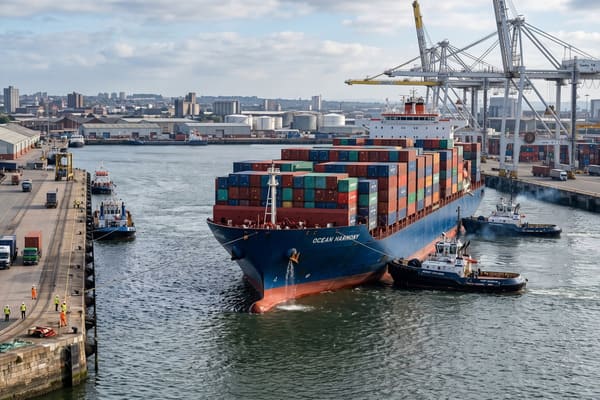
Container shipments arriving at EU ports face intensifying checks — documentation, volumes and trade flows must logically align.
Risk Is Shifting Upstream
For procurement teams, the risk is therefore shifting further upstream. Certification used to function primarily as a final checkpoint. Today, buyers increasingly need to assess whether a supply chain is operationally credible before committing to volume.
Regulation plays a major role in this shift. Regulation (EU) 2018/848 requires operators to implement preventive measures against contamination and mixing. Article 9 specifically obliges companies to establish procedures that protect organic integrity. In practice, this means certificates alone are no longer sufficient during audits or border inspections.
Broader European legislation reinforces this trend further. Under the CSRD, pressure is increasing around demonstrable due diligence in upstream supply chains. At the same time, EUDR processes are pushing companies to integrate supplier information, geolocation data and traceability records into unified operational files.
For food companies, this creates a new reality: documentation quality is becoming increasingly important for operational continuity. The documentation file that supports a shipment is now part of the risk assessment — not just the certificate at the top of it.
Concentrated Markets, Compressed Margins for Error
This is especially relevant in highly volatile categories. The cinnamon market remains heavily concentrated in China and Vietnam, which together account for roughly 89% of global production (JRC, 2025). In turmeric markets, 2025 brought contradictory updates around yields, pricing and available supply volumes (Nedspice, 2025; Plant Lipids, 2025). Under those conditions, pressure on supply chains increases and the likelihood of inconsistencies between production, certification and actual export volumes rises as well.
Procurement therefore shifts increasingly away from price comparison and toward verification capability.

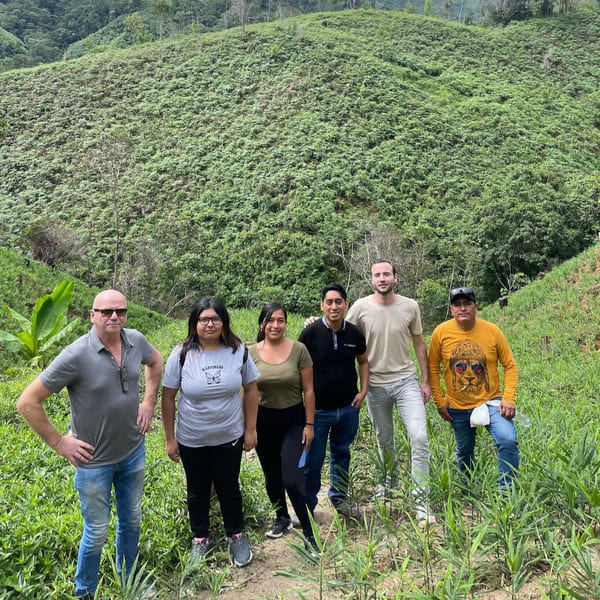
Field-level sourcing in Peru — shorter, more direct supply chains reduce the number of documentation layers that need to remain consistent under EU scrutiny.
How Procurement Is Adapting
For buyers, this means supplier evaluation is becoming more operational.
Many companies now actively compare residue analyses against batch documentation and logistics records. Mass-balance overviews are increasingly requested before contracts are signed rather than during audits. Some importers are building integrated supplier files that combine organic certificates with audit histories, CAPA reports, geolocation data and analytical certificates.
This is not only about caution. It is primarily a response to the financial impact of blocked and rejected shipments.
Ultimately, the largest shift concerns how risk itself is evaluated. In 2026, sourcing organic ingredients depends less on whether a supplier holds a certificate. More important is whether documentation, trade flows and operational processes remain coherent when they are placed under pressure.
A Different Role for Procurement
That also changes the role of procurement inside food companies. Less focus on certificates as endpoints. More focus on verifiability throughout the entire sourcing, import and control process.
The companies moving through this transition most smoothly are those that treat supplier documentation not as a compliance archive but as a live operational tool — something that can be interrogated at any point in the supply chain without producing inconsistencies.
In that sense, the increasing frequency of RASFF notifications and import controls is not just a border management story. It is a signal about what kind of sourcing relationships will remain operationally viable as EU enforcement continues to intensify.
Sources
- RASFF Portal. (2025). Rapid Alert System for Food and Feed notifications — January 2025. European Commission.
- European Commission. (2025). Organic farming in the EU — import statistics and control data. DG AGRI.
- Joint Research Centre (JRC). (2025). Cinnamon authenticity and quality study. European Commission.
- Nedspice. (2025). Turmeric market report — supply and pricing update.
- Plant Lipids. (2025). Turmeric crop and yield outlook 2025.
- European Parliament & Council. (2018). Regulation (EU) 2018/848 on organic production and labelling of organic products. EUR-Lex.
- European Commission. (2025). Corporate Sustainability Reporting Directive — Omnibus update.
- European Commission. (2026). EUDR implementation guidance.