In B2B food, "organic" and "fair trade" are still treated as cousins. They share a sustainability shelf, they get bundled in the same procurement clause, and they tend to surface together in supplier presentations. They are not the same. They never were. And under the regulation now landing across the European Union, the difference between the two is shifting from a marketing detail into a commercial liability.
World Fair Trade Day, on 9 May, is a useful prompt to look at this clearly. Not as a celebration, but as a checkpoint: what exactly does each certification cover, what does it leave out, and what should an importer, food manufacturer or beverage brand actually be asking their ingredient suppliers in 2026?
This is the breakdown.
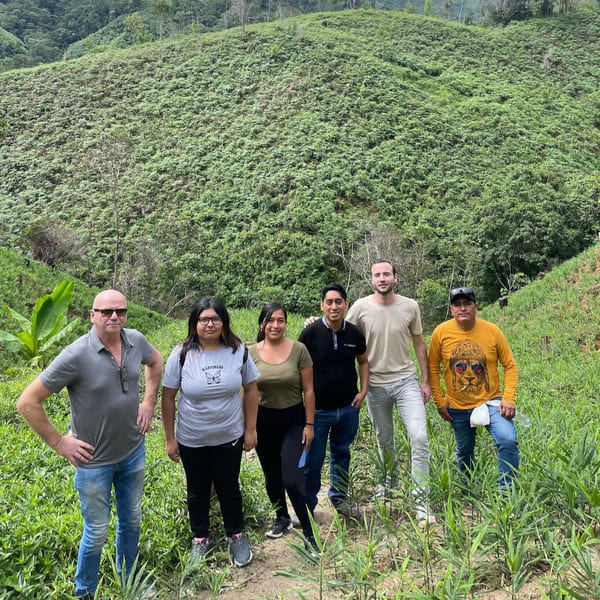
Organic ginger farmers in Peru — organic certification covers how crops are grown, not how farmers are paid.
1. What organic certifies — and what it doesn't
EU organic certification is about the field. The standard is concrete and well-established: no synthetic pesticides, no synthetic fertilizers, no genetically modified inputs, defined rules on rotation, soil management and animal welfare. A farm that holds an EU-organic certificate has demonstrated, through inspection and audit, that its production methods meet those agronomic criteria.
What organic certification does not cover is equally concrete. It says nothing about how the farmer was paid. Nothing about the contract length. Nothing about labour conditions on the farm or the surrounding community. Nothing about the price stability that allows a smallholder cooperative in Peru, India or Egypt to invest in next year's crop.
That is not a weakness of the standard — organic was never designed to certify trade conditions. It is, however, a reason that "organic" alone does not answer most of the questions a procurement team needs to answer in 2026.
2. What fair trade adds — and where the overlap stops
Fair trade certification operates on a different axis. It governs the contract: minimum prices that protect farmers when commodity markets crash, premiums paid into cooperative funds for community investment, multi-year purchasing agreements that give farmers predictability, and labour standards including bans on forced and child labour.
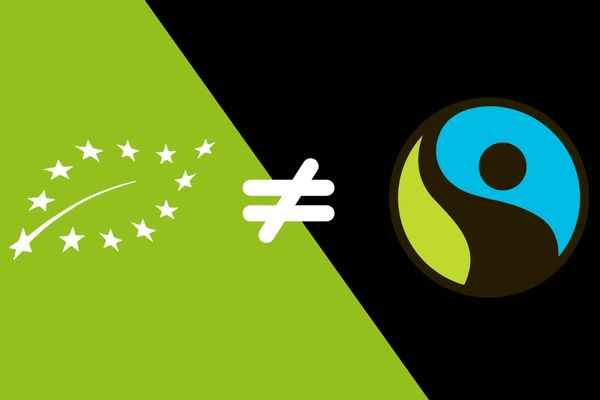
A product can hold both certifications simultaneously — fair trade organic ginger, fair trade organic coffee, fair trade organic cocoa exist and trade at premium. But the existence of a combined product does not mean the standards reinforce each other. They are stacked, not fused. A fair trade ingredient may be conventionally grown. An organic ingredient may sit inside a sourcing relationship with no contract length, no minimum price, and no audit of labour practices on the farm.
For ingredient buyers, this matters because the risk profile of those two products — organic-only versus organic-plus-fair-trade — is materially different, even when the final ingredient is identical.
3. Why this distinction matters more now
For most of the past two decades, organic certification has been sufficient evidence of "responsible sourcing" in B2B procurement. Buyers ticked a box, suppliers produced a certificate, and the conversation moved on. That equilibrium is ending, driven by three EU regulations now phasing in:
CSRD (Corporate Sustainability Reporting Directive) is requiring large companies — and increasingly their suppliers — to report on environmental, social and governance impact across their value chains. "Our ingredients are organic" is no longer a sufficient sustainability statement under the European Sustainability Reporting Standards. Reporting now needs to address human rights, working conditions and supplier engagement throughout the chain.
EUDR (EU Deforestation Regulation), applicable from late 2025 for large operators and 2026 for SMEs, requires that specific commodities — including coffee, cocoa, palm oil, soy, rubber, cattle and timber, plus derived products — are not linked to deforestation after December 2020. Compliance demands geolocation data on the plot of origin. An organic certificate is not evidence under EUDR. Traceability is.
CSDDD (Corporate Sustainability Due Diligence Directive), transposing into national law from 2027 onwards, will require companies above a size threshold to identify, prevent and mitigate adverse human rights and environmental impacts in their operations and value chains — including, explicitly, at the level of indirect business partners. Again: organic certification does not, by itself, demonstrate the diligence the directive requires.
The pattern is consistent. EU policy is moving from product attributes to chain evidence. Organic remains relevant — but it is no longer alone sufficient.
4. What this means for ingredient sourcing
Translating this to the categories we work with at NOW Organic — organic ginger, turmeric, citrus, mandarins, fruit and botanical juice concentrates — the practical implications are concrete.
For ginger and turmeric, sourced largely from India, China and Peru, buyers should expect to see:
- Traceability down to the farmer or cooperative, not just the export company. Plot-level coordinates where applicable.
- Transparent price build-up, showing what the farmer received versus what is added in processing, logistics and trade.
- Multi-year purchasing relationships, which create the conditions under which fair trade premiums and organic compliance can both be sustained.
- Third-party social audits — SMETA, BSCI, SA8000 or equivalent — covering labour practices on the farms and processing facilities.
For citrus and mandarins, where the supply base concentrates in fewer countries (Spain, Egypt, Turkey, parts of Latin America), the same expectations apply, with added attention to seasonal labour conditions, which are a documented risk area in the category.
For juice concentrates, which sit further down the processing chain, the buyer's responsibility extends to the upstream raw-material sourcing — not only the concentrate facility. A traceable concentrate that cannot account for its fruit origin is no longer adequate evidence under the new regime.
This is no longer an ESG-team conversation. It is a procurement-hygiene conversation.
5. What buyers should be doing in 2026
The companies that will move smoothly through the 2026–2028 regulatory transition are doing four things now:
- Updating supplier questionnaires to ask separately about organic certification, fair trade or equivalent social certification, traceability evidence, and EUDR-relevant geolocation data.
- Auditing the existing supplier base against those criteria, with a remediation timeline for suppliers that cannot yet meet them.
- Rewriting procurement contracts to include specific clauses on traceability, audit rights, and supplier obligations under EUDR and CSDDD.
- Aligning sourcing strategy with reporting strategy so that the data flowing in from suppliers is structured to feed CSRD reporting requirements directly, rather than being reconstructed at year-end.
None of this is dramatic. It is, individually, the kind of work procurement teams already do. What is new is the combination: organic, fair trade, traceability, and due diligence are no longer separate sustainability conversations. They are converging into one set of expectations, on one timeline, in one regulatory framework.
World Fair Trade Day is a good moment to take stock of where your sourcing sits on that map — and where it needs to be a year from now.
Frequently Asked Questions
Organic certification covers how an ingredient is grown — no synthetic pesticides, no synthetic fertilizers, no GMOs, defined rules on soil and rotation. Fair trade certification covers how the ingredient is traded — minimum prices for farmers, cooperative premiums, multi-year contracts, labour standards. A product can hold one certification, both, or neither.
No. The two standards are independent. Organic certification under EU rules makes no requirements about price paid to farmers, contract duration, or working conditions on the farm. Fair trade certification makes no requirements about cultivation methods.
The most widely recognised are Fairtrade International (FLO/FLOCERT), Fair Trade USA, Fair for Life, and the World Fair Trade Organization (WFTO) guarantee system. They differ in scope, audit methodology and chain coverage. Most large food manufacturers accept multiple schemes.
No. EUDR compliance requires specific evidence — including, for relevant commodities, geolocation data on the plot of origin and a due diligence statement. Organic certification is not, in itself, that evidence.
CSDDD applies directly to companies above a size threshold (currently set at 1,000 employees and €450M turnover, applied progressively from 2027). However, in-scope companies are required to perform due diligence on their value chains, which means smaller suppliers face increasing demands from larger buyers regardless of whether they are themselves in scope.
References
- European Parliament & Council of the European Union. (2018). Regulation (EU) 2018/848 of the European Parliament and of the Council of 30 May 2018 on organic production and labelling of organic products and repealing Council Regulation (EC) No 834/2007. EUR-Lex. https://eur-lex.europa.eu/eli/reg/2018/848/oj/eng
- Council of the European Union. (2025, December 18). Deforestation: Council signs off targeted revision to simplify and postpone the regulation [Press release]. https://www.consilium.europa.eu/en/press/press-releases/2025/12/18/deforestation-council-signs-off-targeted-revision-to-simplify-and-postpone-the-regulation/
- Fairtrade International. (n.d.). How Fairtrade certification works. Retrieved May 7, 2026, from https://www.fairtrade.net/en/why-fairtrade/how-we-do-it/how-does-the-label-work/how-fairtrade-certification-works.html