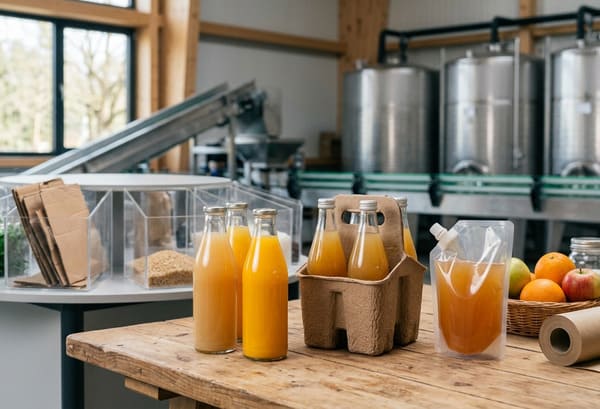
For foodservice wholesalers and catering businesses, bag-in-box is in most cases the better choice over bottles: less risk of breakage behind the bar or in the kitchen, longer freshness after opening because no air reaches the product during pouring, less storage volume because the boxes are stackable, and direct compatibility with existing beverage dispensers. Bottles remain relevant where table presentation matters, but for bulk use behind the bar or in the kitchen, bag-in-box is almost always the more logical option operationally and financially.
For organic ginger and turmeric juice, there's a practical size that stands out: 3 litres is the most commonly chosen bag-in-box format for foodservice and catering, because it matches the consumption rate of an average bar or professional kitchen. This guide walks through why that is, what bag-in-box delivers concretely compared with bottles, and which other formats are available once volume grows.
1. What exactly is bag-in-box packaging?
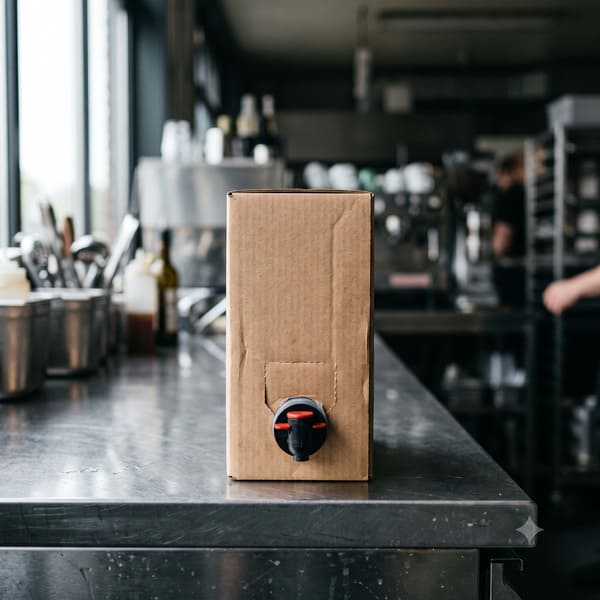
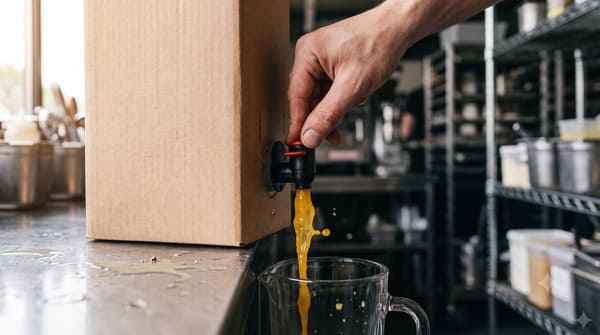
Bag-in-box consists of a flexible, multi-layer plastic inner bag with a tap, packed inside a sturdy cardboard outer box. During pouring, the bag collapses instead of air entering to fill the space, as happens with a bottle. That principle is the core of almost every advantage bag-in-box has over glass or PET for professional use.
For organic ginger juice and turmeric juice, this format is already used as standard alongside bottles, drums, and tank loads, precisely because it matches how foodservice and catering actually use the product: portioning by consumption, not by a fixed bottle size.
2. Why is 3 litres the most commonly chosen size for foodservice?
3 litres is large enough that you don't need to change it every service, and small enough to fit behind the bar, in a fridge, or on a catering buffet without the product sitting open too long before it's finished. For an average bar or restaurant kitchen, that's the balance between ease of changeover and freshness.
- Smaller foodservice venues and cafés typically choose 3L, matching daily or weekly consumption per product line.
- Larger kitchens, hotels, and catering businesses often move to 5L or 10L once consumption and cover counts increase.
- Central kitchens and distributors supplying multiple locations more often work with 20L bag-in-box or drums.
3. How long does the juice stay fresh after opening the box?
Because the inner bag of a bag-in-box collapses during pouring instead of letting air in, oxidation after opening is significantly reduced compared with a bottle that lets in more air with every pour. That matters for foodservice: an opened bag stays usable across multiple services without the quality loss an opened bottle shows quickly.
The precise shelf life after opening and the required storage temperature vary by product and pack format; ask about this when ordering so the foodservice or catering business can plan the right stock rotation.
What this means for the bar or kitchen: less product wasted to oxidation, less frequent changeovers, and a consistent taste from the first pour to the last.
4. What practical advantages does bag-in-box offer behind the bar or in the kitchen?
Besides shelf life, several direct advantages come into play in day-to-day operations:
- No breakage risk. No glass behind the bar or in a busy kitchen means less risk of broken bottles, glass splinters in food, and injury to staff.
- Direct dispenser compatibility. Bag-in-box is the standard format for postmix and beverage dispensers, with a tap or connector that fits existing equipment.
- Consistent portioning. The tap doses in a controlled way, which helps keep track of the cost per serving on the menu.
- Less storage volume. The rectangular boxes are stackable, unlike round bottles, saving space in a cold room or storeroom where every square metre counts.
- Fewer stock movements. One 3L box replaces multiple bottles, reducing how often stock has to be replenished or swapped out.
5. Is bag-in-box also more sustainable than bottles?
Per litre delivered, bag-in-box uses considerably less packaging material than glass or PET: the cardboard outer box and the plastic inner bag together weigh far less than a bottle holding the same volume, and less air and weight is transported. Cardboard and plastic are collected separately after use and are both standard recycling streams.
Under the EU Packaging Regulation (PPWR), it's mainly the recyclability class of the material used that counts, not just the weight. For buyers already looking ahead to the requirements heading toward 2030, that's a reason to review packaging choices per SKU, not only on the basis of unit cost.
6. What other formats are available besides 3L bag-in-box?
NOW Organic's organic ginger and turmeric juice is available in bag-in-box from 3L, 5L, 10L, and 20L, in 200L drums, or as 25MT tank loads for larger contracts, with year-round availability. That makes it possible to scale from a single foodservice venue to a catering chain or central kitchen without switching supplier.
For brands and distributors who want to build their own range around this juice, private label under your own brand is also possible from qualifying volumes.
7. How does this fit into a broader alcohol-free or functional drinks range?
Ginger and turmeric juice in bag-in-box is used in foodservice not only as a standalone pour, but also as a spiced, functional base for mocktails and alcohol-free mixed drinks. For a foodservice wholesaler looking to expand its alcohol-free range, that's a direct application alongside the packaging choice itself; read more about what declining alcohol consumption means for your drinks range.
8. How do you request a quote or sample?
Price per litre is determined by format, order volume, and incoterm. Contact us with your preferred format, volume, and delivery frequency for a tailored quote; our team typically responds within 12 hours. Certification details, including EU Organic via SKAL Bio Controle, are on our FAQ page.
Frequently Asked Questions
3 litres matches the consumption rate of an average bar or kitchen: large enough that you don't need to change it every service, small enough to fit behind the bar or in a fridge and be finished before quality declines. For venues with higher consumption or central kitchens, 5L, 10L, and 20L bag-in-box are available in the same format.
A bag-in-box works with a collapsible inner bag, so no air reaches the product during pouring. That significantly limits oxidation after opening compared with a bottle, which lets in more air every time it's opened. Exact shelf life after opening varies by product and storage temperature.
Bag-in-box uses considerably less packaging material per litre delivered than glass or PET, because the cardboard outer box and the plastic inner bag together are much lighter than a bottle holding the same volume. Cardboard and plastic are collected separately after use. Under the EU Packaging Regulation (PPWR), the recyclability of the materials used is what matters, not just the weight.
Yes. Organic ginger and turmeric juice is available in bag-in-box of 3L, 5L, 10L, and 20L, alongside 200L drums and 25MT tank loads for larger buyers. Contact us with your preferred format and volume for a tailored quote.